
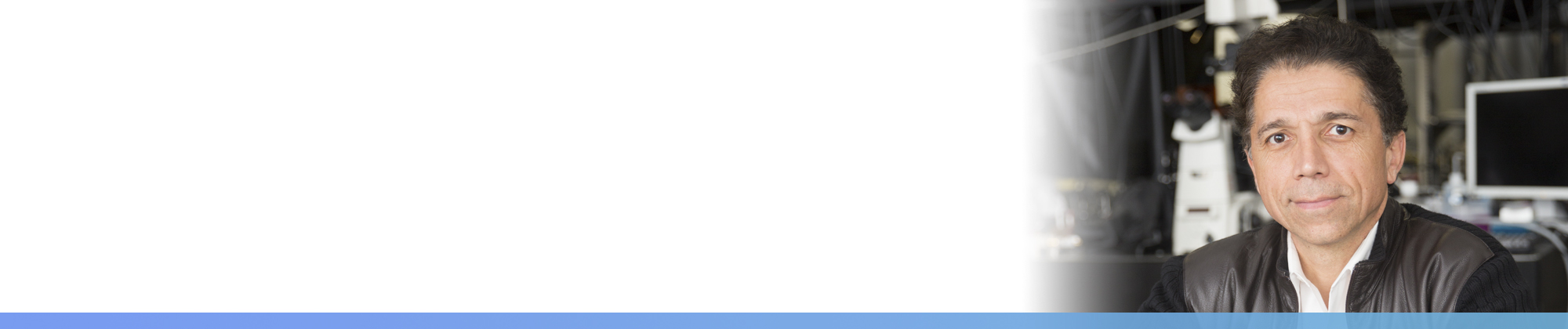
Bahram Jalali
DISTINGUISHED PROFESSOR EMERITUS
BIOENGINEERING
ELECTRICAL AND COMPUTER ENGINEERING
68-109 ENG IV
Email: jalali@ucla.eduPhone: (310) 825-9655
Websites
Bahram Jalali is a professor emeritus of electrical and computer engineering at UCLA, with joint appointments in bioengineering and the California NanoSystems Institute (CNSI).
Jalali received his Ph.D. in applied physics from Columbia University in 1989 and was with the Physics Research Division of Bell Laboratories in Murray Hill, New Jersey from 1988 to 1992 before joining UCLA. He is a member of the National Academy of Inventors (NAI), Fellow of IEEE, OSA, APS, AIMBE, and SPIE. He is the recipient of the R.W. Wood Prize from the Optical Society of America for creating the first silicon laser, the Aaron Kressel Award from IEEE, and the Achievement Medal from IET (U.K), and the Pioneer in Technology Award from the Society of Brain Mapping & Therapeutics. He is the inventor of the time stretch and the radiofrequency imaging and sensing modalities that have been commercialized for applications to blood screening.
In 2022, Jalali was elected as a member of the National Academy of Engineering. He is also a member of the UCLA Parker Institute for Cancer Immunotherapy (PICI). He has been elected into the Scientific American Top 50 and MIT Technology Review Magazine Top 10 and has served on the board of directors of the California Science Center, the Brentwood School, and was a member of the Institute of Defense Analysis' Microsystem Exploratory Council. He currently serves on the Board of Visitors of Columbia University School of Engineering.
Jalali received his Ph.D. in applied physics from Columbia University in 1989 and was with the Physics Research Division of Bell Laboratories in Murray Hill, New Jersey from 1988 to 1992 before joining UCLA. He is a member of the National Academy of Inventors (NAI), Fellow of IEEE, OSA, APS, AIMBE, and SPIE. He is the recipient of the R.W. Wood Prize from the Optical Society of America for creating the first silicon laser, the Aaron Kressel Award from IEEE, and the Achievement Medal from IET (U.K), and the Pioneer in Technology Award from the Society of Brain Mapping & Therapeutics. He is the inventor of the time stretch and the radiofrequency imaging and sensing modalities that have been commercialized for applications to blood screening.
In 2022, Jalali was elected as a member of the National Academy of Engineering. He is also a member of the UCLA Parker Institute for Cancer Immunotherapy (PICI). He has been elected into the Scientific American Top 50 and MIT Technology Review Magazine Top 10 and has served on the board of directors of the California Science Center, the Brentwood School, and was a member of the Institute of Defense Analysis' Microsystem Exploratory Council. He currently serves on the Board of Visitors of Columbia University School of Engineering.
RESEARCH AND INTERESTS
- Silicon Photonics
- Bioimaging and screening
- Physics-inspired Algorithms
- Nonlinear Dynamics
- Artificial Intelligence
NOTABLE PUBLICATIONS
- K. Goda and B. Jalali, Dispersive Fourier transformation for fast continuous single-shot measurements, Nature Photonics 7, 102 (2013)
- K. Goda, A. Ayazi, D. R. Gossett, J. Sadasivam, C. K. Lonappan, E. Sollier, A. M. Fard, S. C. Hur, J. Adam, C. Murray, C. Wang, N. Brackbill, D. Di Carlo, and B. Jalali, “High-throughput single-microparticle imaging flow analyzer,” Proceedings of the National Academy of Sciences 109, 11630 (2012)
- D. R. Solli, G. Herink, B. Jalali, and C. Ropers, “Fluctuations and correlations in modulation instability,” Nature Photonics 6. 463 (2012)
- K. Goda, A. Mahjoubfar, C. Wang, A. Fard, J. Adam, D. R. Gossett, A. Ayazi, E. Sollier, O. Malik, E. Chen, Y. Liu, R. Brown, N. Sarkhosh, D. Di Carlo, and B. Jalali, “Hybrid dispersion laser scanner,” Scientific Reports 2, 445 (2012)
- D. R. Solli, B. Jalali, and C. Ropers, “Seeded supercontinuum generation with optical parametric down-conversion,” Physical Review Letters 105, 233902 (2010)
- Tan Z., Wang C., Goda K., Malik O., Jalali B., “Jammed-array wideband sawtooth filter,” Opt Express. 2011 Nov 21;19(24):24563-8.
- Diebold E.D., Hon N.K., Tan Z., Chou J., Sienick T., Wang C., Jalali B., “Giant tunable optical dispersion using chromo-modal excitation of a multimode waveguide” Opt Express. 2011 Nov 21;19(24):23809-17.
- Fard A., Yang J.Y., Buckley B., Wang J., Chitgarha M.R., Zhang L., Willner A.E., Jalali B., “Time-stretch oscilloscope with dual-channel differential detection front end for monitoring of 100 Fb/s return-to-zero differential quadrature phase-shift keying data,” Opt Lett. 2011 Oct 1;36(19):3804-6.
- Fard A., Gupta S., Jalali B., “Digital broadband linearization technique and its application to photonic time-stretch analog-to-digital converter,” Opt Lett. 2011 Apr. 1l36(7):1077-9.
- Kim S.H., Goda K., Fard A., Jalali B., “Optical time-domain analog pattern correlator for high-speed real-time image recognition,” Opt Lett. 2011 Jan 15;36(2):220-2.
IN THE NEWS
AWARDS AND RECOGNITION
- National Academy of Inventors (2020)
- Distinguished Engineering Achievement Award from the Engineering Council “For seminal contributions in establishing the field of silicon photonics and for time stretch techniques resulting in a new generation of real time high throughput instruments”., 2013
- Fellow, Society of Photo-Optical Instrumentation Engineers, 2013
- IEEE Photonics Society’s Aron Kressel Award “For contributions to the science and technology of silicon photonics”., 2012
- Fellow, American Physical Society, 2011
- R.W. Wood Prize from the Optical Society of America “For the Invention and Demonstration of Raman Lasing in Silicon”, 2007
- “Scientific American 50”, 2006
- Advanced Solid State Photonics (ASSP) Conference, Best Student Paper Award, Graduate student V. Raghunathan (Professor B. Jalali, advisor), 2006
- Fellow of the Optical Society of America, 2004
- Best Paper Award, First ADC Forum (IMTC), 2003
- IEEE Fellow, 2003
- BridgeGate 20 Award, 2001
- IEEE Lasers and Electro-Optical Society Distinguished Lecturer Award, 1998