
We develop algorithmic techniques to solve fundamental problems in analog/mixed-signal/RF IC design. The central idea is that algorithmic techniques can be agnostic to the vagaries of any particular IC fabrication technology or application, insensitive to fabrication process variations, and can be implemented reliably using digital logic circuitry that is abundant and inexpensive in finely scaled CMOS IC fabrication processes. We develop the theory behind the techniques and also built record-setting ICs to demonstrate their effectiveness. In terms of applications, our focus is broad, ranging from circuits for wireless and wireline communications, all kinds of clocking, and more recently, computing applications which have, once again, become very important owing to the push of big data and AI.
| Front-Ends for Software and Congnitive Radio Receivers | ||
|---|---|---|
 |
|
|
|
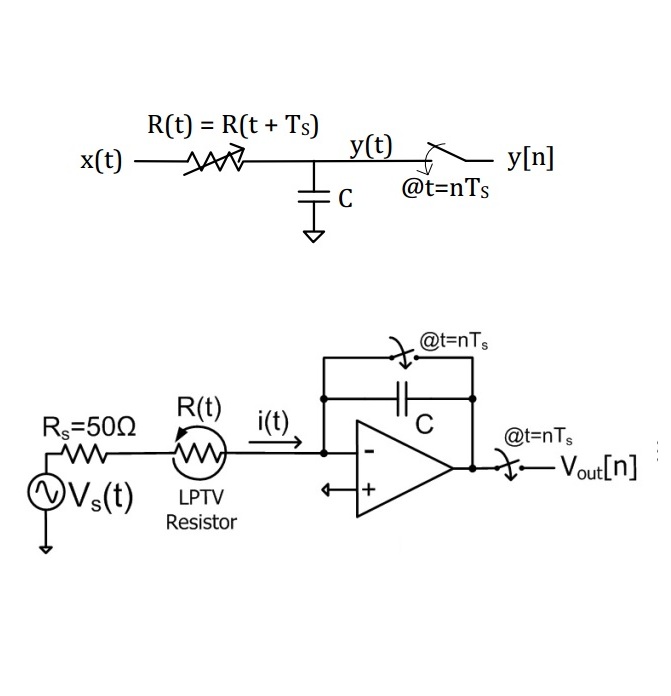
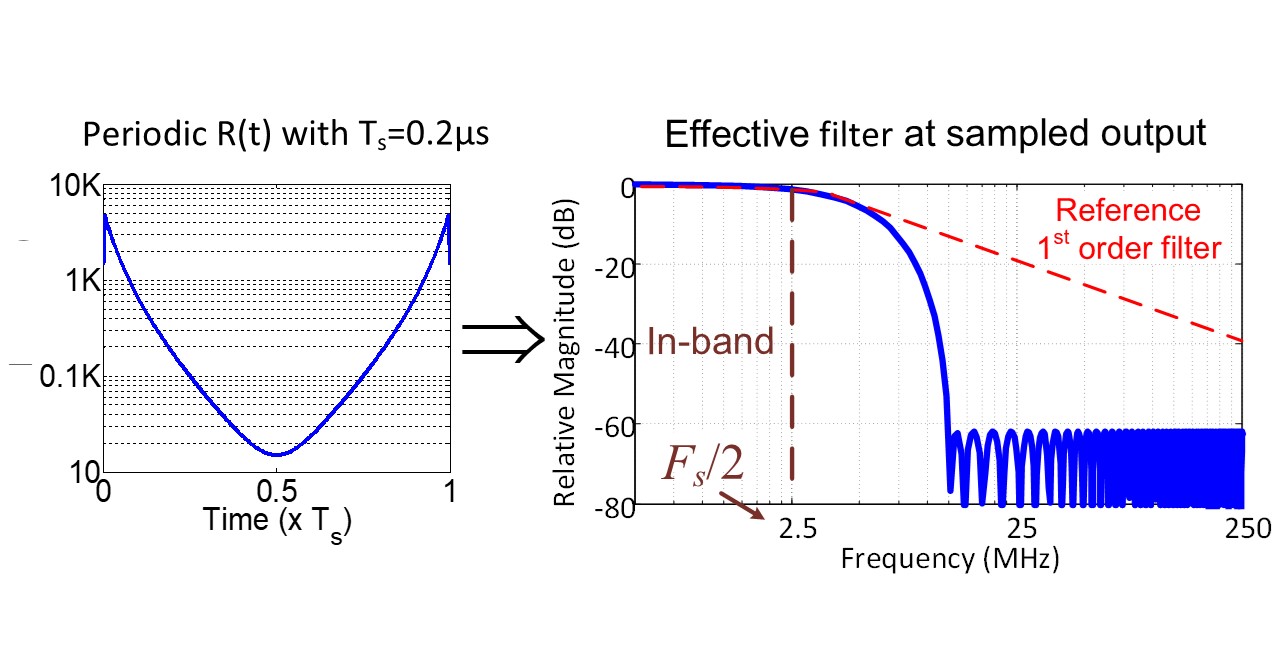
As communications technology migrates towards wideband software-defined radios (SDR) and cognitive radios (CR), receivers are expected to dynamically acquire or monitor one or more signals of interest whose frequency locations, bandwidths, and interference scenarios may not be known apriori. Off-chip filters (e.g., SAW filters), which are employed in traditional receivers, provide the requisite sharp filtering but are too bulky, costly, and inflexible to satisfy the needs of SDR and CR. Integrated filters that meet the associated sharpness, linearity, and programmability requirements using existing filtering techniques are either impossible or prohibitive in terms of power, area, and/or cost. Our group has been pioneering the use of periodically time-varying (PTV) components in receiver front end circuits as a digital-friendly means of achieving sharp filtering, excellent linearity, and low power consumption. This reverses decades-old dogma of using LTI systems along with at most a few mixers to achieve desired frequency down-conversions e.g., mixer-first and N-path approaches. For example, by dynamically changing the resistor value in a 1st order RC circuit in a pre-determined manner, and subsequently sampling the capacitor voltage, effectively an 8th order Butterworth filter can be realized! The LPTV circuit effectively appears as a sharp linear time-invariant (LTI) filter from the continuous-time input to the final sampled output of concern. In the past, we have theoretically established the basis of this fundamentally new PTV technique [Rachid13] and demonstrated multiple prototype CMOS ICs based on this technique. Among them, we demonstrated multiple SDR receiver front-ends with sharp, programmable filtering [Hameed17, Hameed18], with the best reported linearity and blocker-tolerance at the time of publication. We also demonstrated a purely passive spectrum scanner with the best reported linearity and lowest reported power consumption [Sinha17]. Furthermore, we have developed a mathematical tool to analyze the performance of PTV circuits based on vector-extensions of traditional circuit laws such as KVL and KCL [Hameed16]. Note that analysis of PTV circuits involves incredibly tedious mathematics and has been one of main reasons behind the lack of their widespread adoption. Most recently, we have developed a new slice-based circuit architecture that achieves PTV operation by combining a time-varying number of nominally linear time-invariant (LTI) slices. This allows much of the design to proceed using simple LTI intuition thereby addressing a basic difficulty in using PTV circuits. Furthermore, the slice-based architecture presents a mostly LTI input impedance allowing easy concatenation with other LTI circuits. We demonstrated carrier aggregation using the slice-based architecture with the lowest reported LO leakage and best reported linearity even at just 0.9V supply. Note that high LO leakage has been a significant problem with all varieties of mixer-first and N-path receiver prior art. Currently, we are working on developing a technique to cancel any residual interferers that are not sufficiently suppressed by our PTV system. We will employ digitally controlled LMS techniques to maximize achievable residue cancellation [Bu22]. |
||
| Key Publications: | ||
|
[Rachid13] M. Rachid, S. Pamarti, and B. Daneshrad, "Filtering by aliasing," IEEE Transactions on Signal Processing, vol. 61, no. 9, pp. 2319-2327, May 2013. [link] [Hameed16] S. Hameed, M. Rachid, B. Daneshrad, and S. Pamarti, "Frequency-domain analysis of N-path filters using conversion matrices," IEEE Transactions on Circuits and Systems II, Express Briefs, vol. 63, no. 1, pp. 74-78, Jan. 2016. [link] [Sinha17] Sinha, N.; Rachid, M.; Pavan, S.; Pamarti, S., "Design and Analysis of an 8 mW, 1 GHz Span, Passive Spectrum Scanner With >+31dBm Out-of-Band IIP3 Using Periodically Time-Varying Circuit Components," IEEE Journal of Solid-State Circuits, vol.52, no.8, pp.2009-2025, Aug. 2017. [link] [Hameed17] S. Hameed and S. Pamarti , "A time-interleaved filtering-by-aliasing receiver front-end achieving >70dB suppression at <4xBandwidth frequency offset", Solid-State Circuits Conference Digest of Technical Papers (ISSCC), 2017 IEEE International , pp.418,419, 5-9 Feb. 2017. [link] [Hameed18] Hameed, Sameed; Pamarti, Sudhakar, "Design and Analysis of a Programmable Receiver Front End With Time-Interleaved Baseband Analog-FIR Filtering," Solid-State Circuits, IEEE Journal of , vol.53, no.11, pp.3197-3207, Nov. 2018. [link] [Bu22] S. Bu and S. Pamarti, "A Dual-Channel High-Linearity Filtering-by-Aliasing Receiver Front-End Supporting Carrier Aggregation," in IEEE Journal of Solid-State Circuits, vol. 57, no. 5, pp. 1457-1469, May 2022. [link] |
||
| Open Loop Frequency/Phase Synthesis | ||
|---|---|---|
|
|
|
|
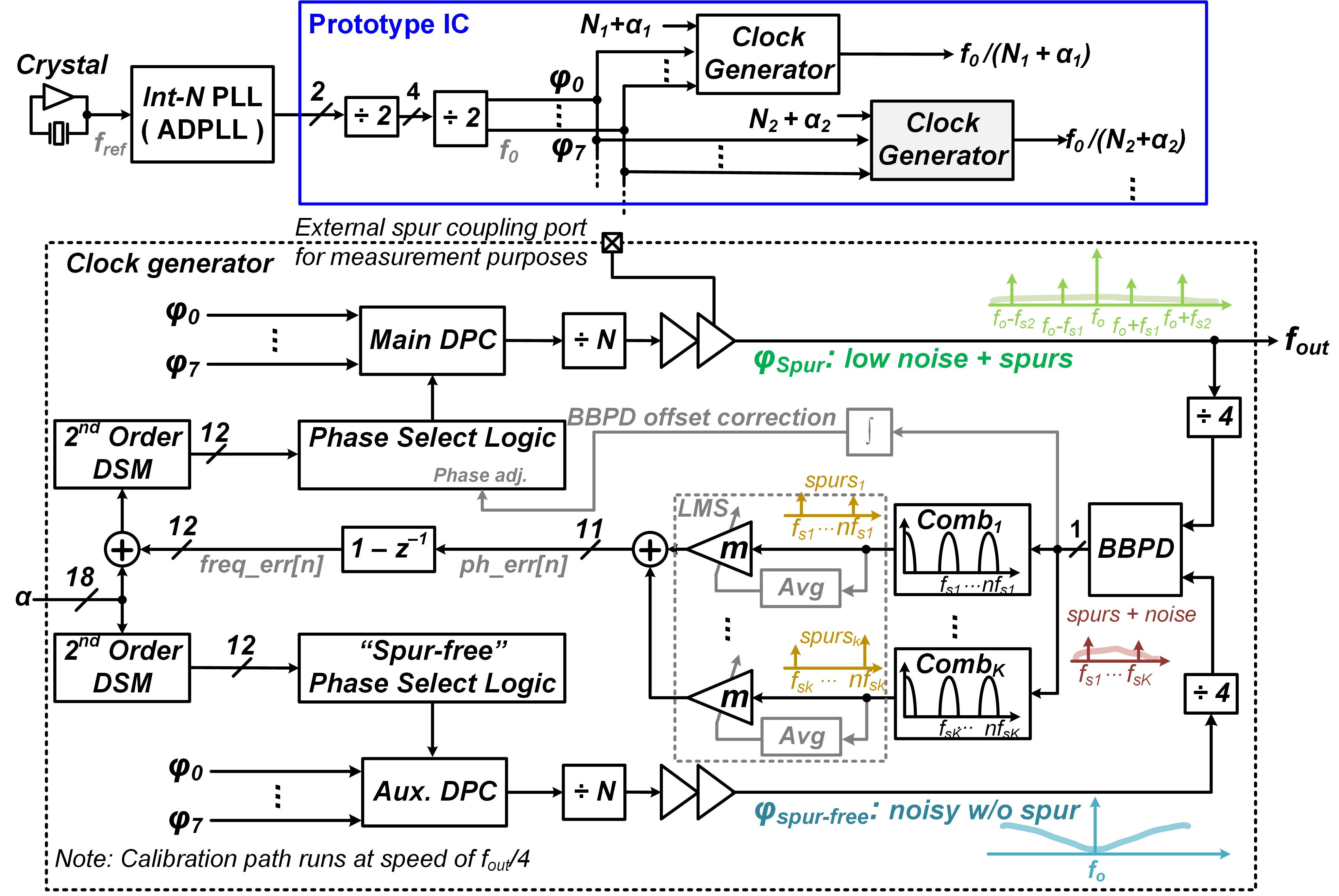
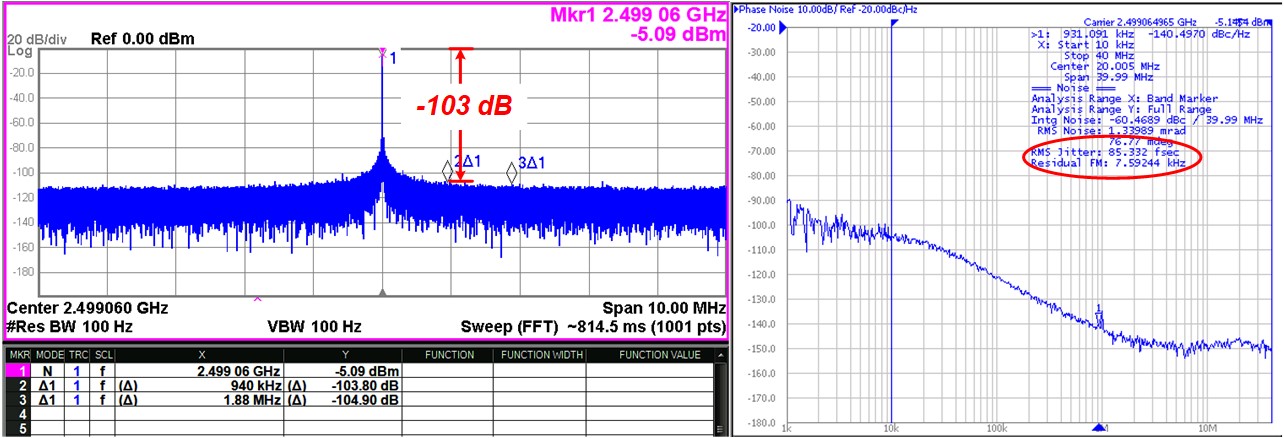
Traditional frequency/phase synthesis employs a power- and area-hungry oscillator in a low bandwidth negative feedback loop. While very successful so far, this approach is problematic in many applications that require either wide bandwidth e.g., radar and newer high-efficiency switching power amplifier architectures, or many clock signals e.g., MIMO and other beam-forming applications, or both. Open-loop frequency/phase synthesis, commonly clubbed under categories such as Direct Digital Frquency Synthesis (DDFS), fractional frequency division, digital-to-phase conversion (DPC) etc. can address these problems. However, these approaches are beset by circuit mismatch isses and exhibit unfavorable trade-offs between phase quantization noise, spur performance, modulation bandwidth and power consumption. To break this trade-off, we have developed multiple techniques such our a predictive phase quantization noise cancellation [Su11] and automatic digital calibration to enable 10b ENOB performance [Nidhi17]. In all these cases, our prototype ICs achieved lower power consumption and phase noise than prior art in significantly more advanced technologies. Recently, we have demonstrated an open loop DPC technique that generates multiple harmonically un-related, fractionally divided clock frequencies from a single high frequency low noise clock signal that achieved integrated jitter < 90fs and spurious tones < -103dBc on a 2.4 GHz [Hung19]. The spurious tones level is 33dB better than the best in prior art! The technique epitomizes our approach of using signal processing techniques to overcome circuit challenges. It leverages our work on the theory of dithered quantizers to generate a spur-free (but noisy) clock and uses it to digitally remove spurious tones in low-noise desired clock beset by spurious tones. Currently, we are working on further advancing such digital spur cancellation techniques. |
||
| Publications: | ||
|
[Su11] P.-E. Su and S. Pamarti, "A 2.4 GHz wideband open-loop GFSK transmitter with phase quantization noise cancellation," IEEE Journal of Solid-State Circuits, vol. 46, no. 3, pp. 615-626, Mar. 2011. [link] [Nidhi17] N. Nidhi and S. Pamarti, "Design and analysis of a 1.8-GHz open-loop modulator for phase modulation and frequency synthesis using TDC-based calibration," IEEE Transactions on Microwave Theory and Techniques, vol. 60, no. 10, pp. 3975-3988, Oct. 2017. [link] [Hung19] Szu-Yao Hung and Sudhakar Pamarti, "A 0.5-2.5 GHz Multi-Output Fractional Frequency Synthesizer with 90fs Jitter and -106dBc Spurious Tones Based on Digital Spur Cancellation", IEEE International Solid-State Circuits Conference (ISSCC), pp 262~263, 2019.[link] | ||
| Clocking for IoT Applications | |
|---|---|
|
|
|
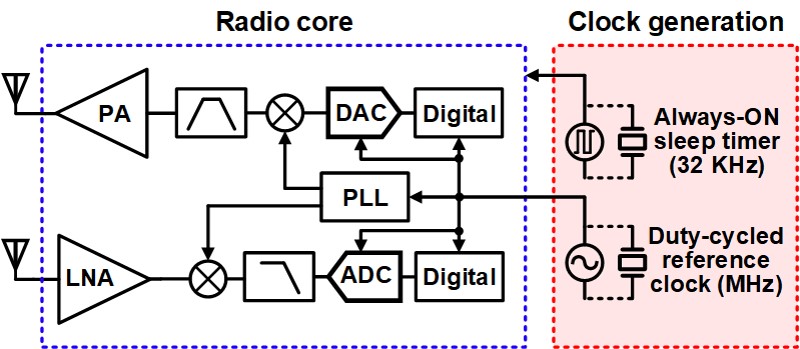
Clocks play a central role in IoT devices. Apart from their typical use in communications, localization, timing mixed-signal and digital logic units etc., they also serve as an always-ON time-keeper and provide timing for aggressive duty cycling of power-hungry blocks. The last two use cases have a great impact on overall system energy consumption of several IoT devices, and require clocks that are simultaneously stable and consume low energy. We have developed two important techniques that improve the state-of-the-art in IoT clocking: a technique to quickly startup a crystal oscillator (XO), and another technique to achieve sub-nW 32kHz XO operation. Quickly starting up an XO allows aggressive duty cycling of parts of a system including the XO. This is extremely important to reducing overall energy consumption and prolong battery life in IoT and sensor nodes. Quick XO startup is a challenge that has resisted decades of research. Our simple solution involves pre-energizing the high-Q crystal for a short but precise duration. We have demonstrated, in a CMOS prototype, XO startup in just 100 cycles, which is about 20x faster than competition, and is far more tolerant of PVT variations [Esmaeelzadeh18]. We have also demonstrated the world’s first sub-nW 32kHz XO for real time clock applications, based on a new PTV sustaining amplifier that uses a DC-only sustaining amplifier [Esmaeelzadeh19]. Since this oscillator always stays ON to facilitate duty cycling of active circuitry in IoT devices, this promises to have a significant impact on IoT device battery life. Currently, we are interested in addressing the stability issues of crytal-free clocking systems. |
|
| Publications: | |
|
[Esmaeelzadeh18] H. Esmaeelzadeh and S. Pamarti, "A quick startup technique for high-Q oscillators using precisely timed energy injection," IEEE Journal of Solid-State Circuits, vol. 53, no. 3, pp. 692-702, Mar. 2018.[link] [Esmaeelzadeh19] H. Esmaeelzadeh and S. Pamarti, "A sub-nW 32-kHz crystal oscillator architecture based on a DC-only sustaining amplifier," IEEE Journal of Solid-State Circuits, vol. 54, no. 12, pp. 3247-3256, Dec. 2019. [link] |
| Advanced Computing Hardware | |
|---|---|
|
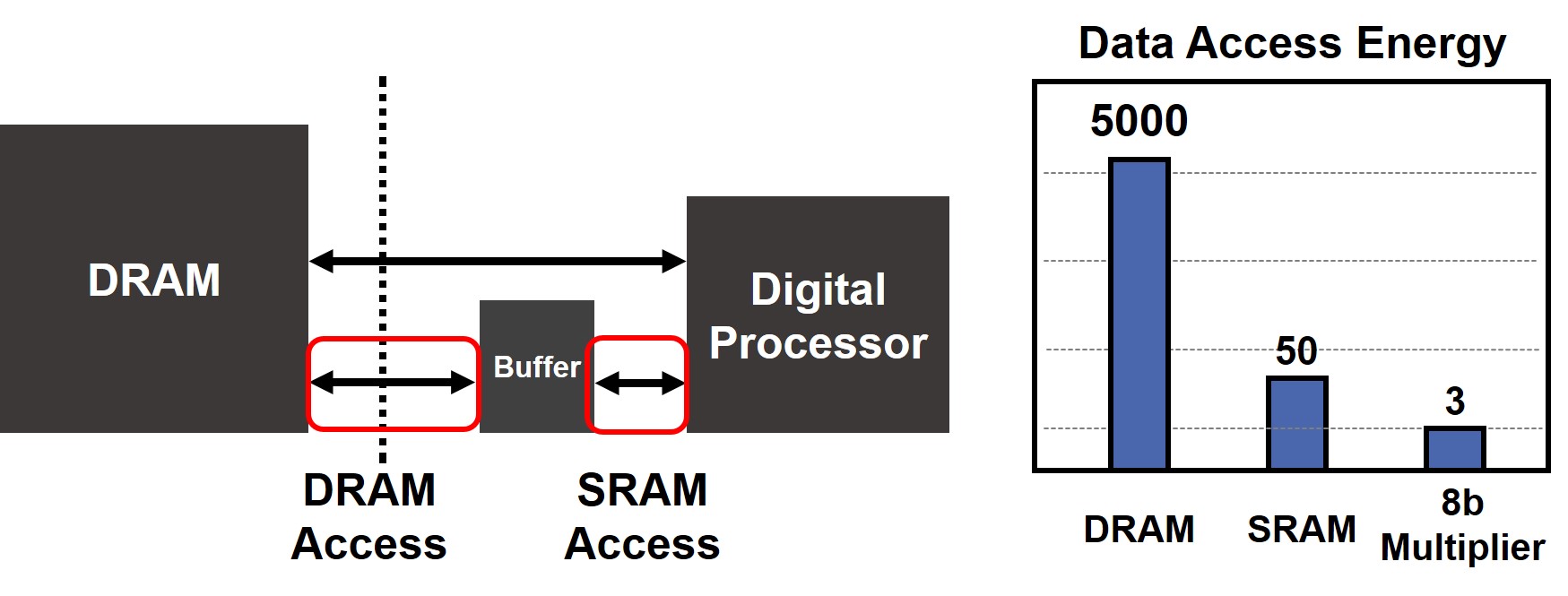
The rapid development of ML applications has placed a renewed demand to address the fundamental challenges and bottlenecks in computing hardware in ferrying large amounts of data between memory and computing units. This so-called memory bottleneck problem is a decidedly multi-disciplinary problem with devices, technology, circuits, and architecture playing equally important roles. Accordingly, we have been collaborating with colleagues on three main fronts. |
|
|
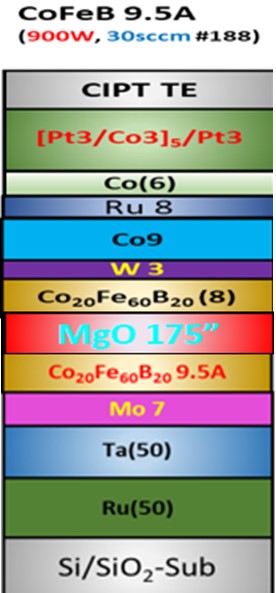
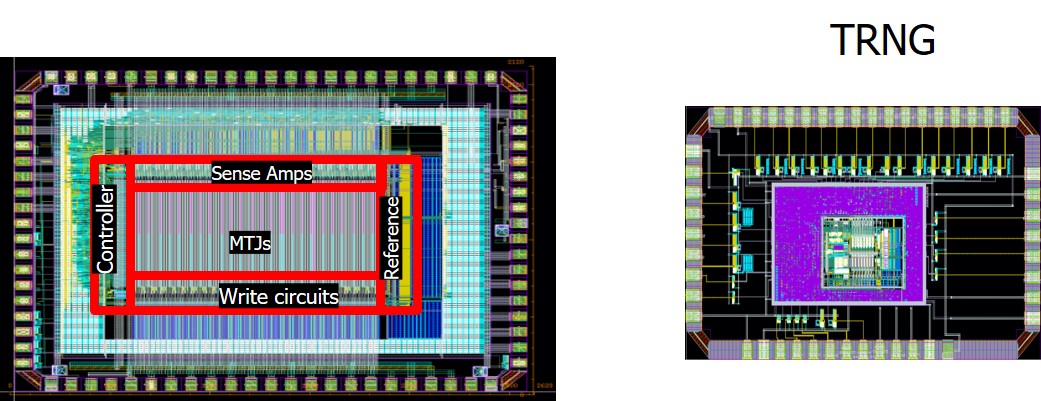
(A) Magnetic memory circuits: We have been developing read/write circuits and in-memory-array true random number generators based on a new CMOS-compatible voltage-controlled magnetic tunneling junction (VC-MTJ) device from Prof. Kang Wang's group. These new devices promise the best energy, density, and retention/non-volatility properties of any non-volatile memory device. Such high density, low energy, non-volatile memory will solve the important challenge of storing large machine learning models on-chip. We have demonstrated the world's first integrated VC-MTJ based memory arrays on traditional CMOS wafers designed CMOS access circuitry [Suhail23]. We have also demonstrated VC-MTJ based true random number generators that have passed all NIST randomness tests [Yang21]. |
 |
 |
|
|
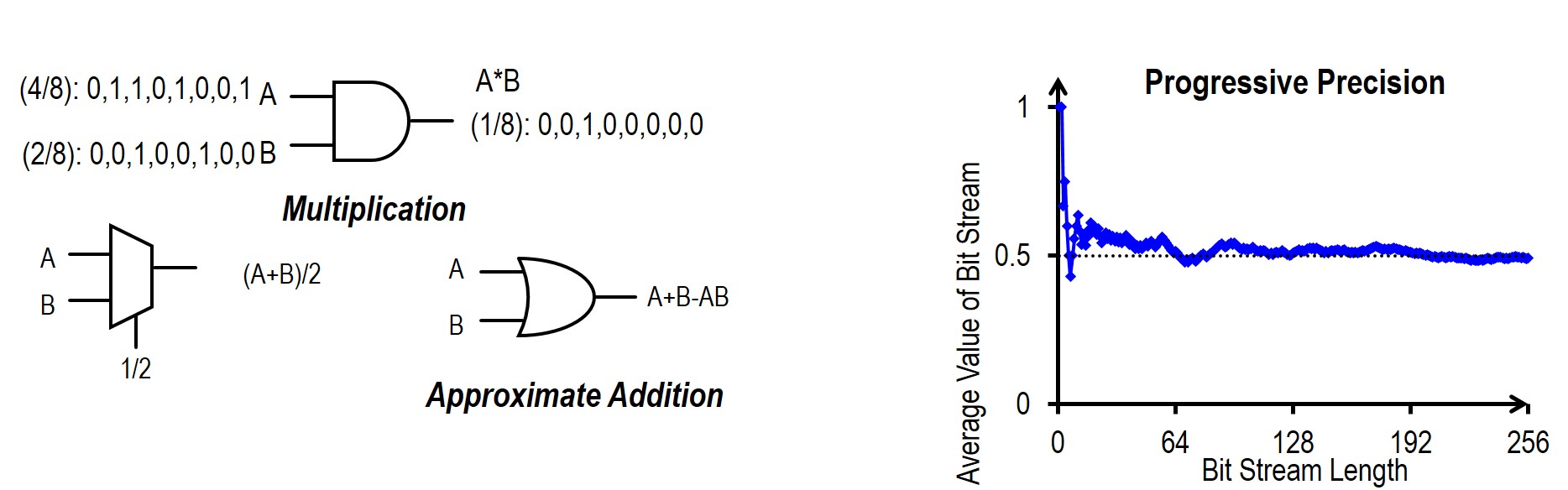
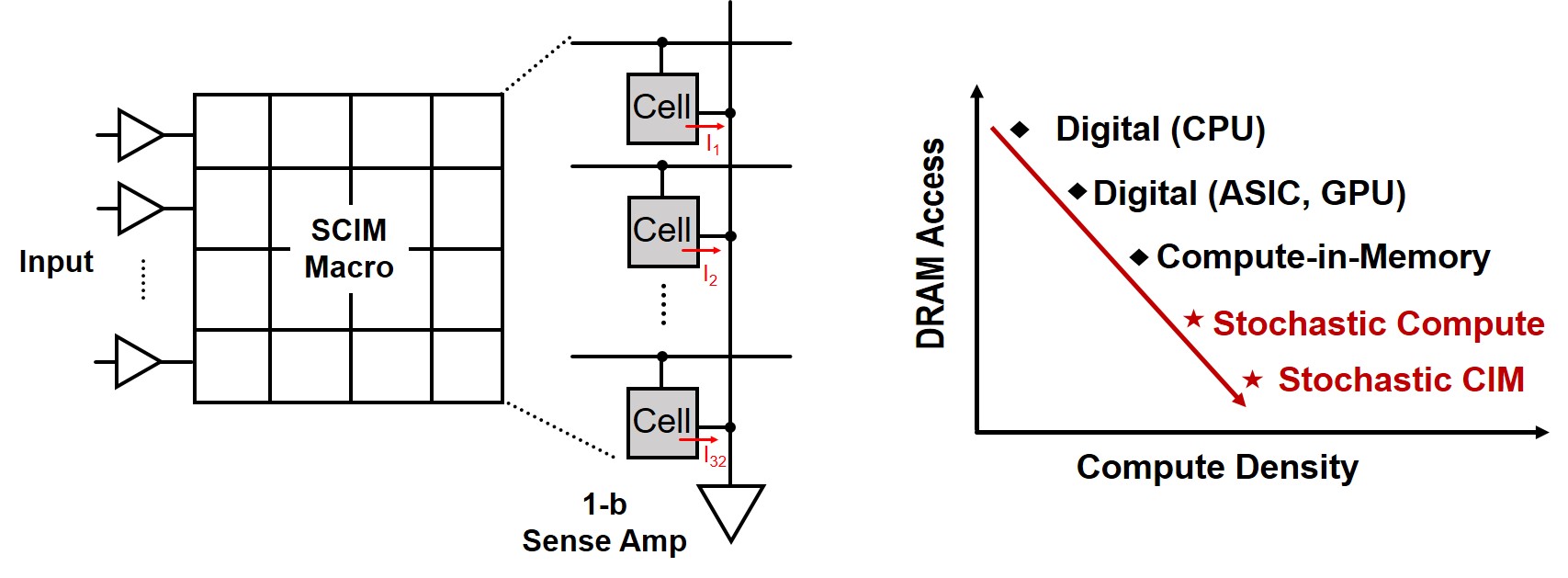
(B) Stochastic computing: In collaboration with Prof. Puneet Gupta's group, we have been working on an unconventional computing system that represents numbers as binary random streams rather than in fixed-point or floating-point. This stochastic representation renders basic computational units, MACs, exceedingly small thereby allowing massive on-chip parallelization of compute. Our approach mitigates the memory bottleneck problem of modern computing system, can reduce the energy-delay product (EDP) by about 2 orders, and in addition, dynamically trades compute accuracy for energy and latency, all of which are crucial for enabling edge AI. We have developed a stochastic compute-in-memory architecture that combines the benefits of stochastic computing with the recently popular compute-in-memory approach while eliminating the need for sophisticated DACs and ADCs that plague the latter. We have demonstrated EDP improvements over digital and analog in-memory compute versions of fixed-point accelerators while maintaining comparable inference accuracy [Romaszkan20, Yang22, Romaszkan22]. |
 |
 |
|
|
(C) Silicon interposer based computing systems: We are working with Prof. Subramanian S. Iyer and Prof. Puneet Gupta, under the UCLA CHIPS umbrella, to enable large wafer scale computing systems wherein hundreds or thousands of small dielet based cores are connected together using Prof. Iyer's very fine pitch (sub-10um) Si interposer according to architectures developed by Prof. Gupta's group. There is a strong demand for such powerful machines especially in big data applications. Our contributions are in designing clocking, I/O, and power supply regulation circuits. Multi-core systems are not new but the wafer scale systems and the small dielet size present a completely new set of challenges of scale especially for clocking and on-die power regulation. |
|
|
(D) Low temperature computing: We are currently working with Prof. Ken Yang and Prof. Puneet Gupta in developing the circuit and microarchitectural techniques that can exploit the benefits of operating digital machines at very low temperatures (around 77K). Our contributions are in the areas of clocking and I/O development. |
|
| Key Publications: | |
|
[Romaszkan20] W. Romaszkan, T. Li, T. Melton, S. Pamarti, and P. Gupta, "ACOUSTIC: accelerating convolutional neural networks through or-unipolar skipped stochastic computing," in Proceedings of IEEE/ACM Design, Automation and Test in Europe (DATE), Grenoble, France, Mar. 2020, pp. 768-773.[link] [Yang22] J. Yang, T. Li, W. Romaszkan, P. Gupta and S. Pamarti, "A 65nm 8-bit All-Digital Stochastic-Compute-In-Memory Deep Learning Processor," 2022 IEEE Asian Solid-State Circuits Conference (A-SSCC), Taipei, Taiwan, 2022, pp. 10-11. [link] [Romazkan22] W. Romaszkan, T. Li, R. Garg, J. Yang, S. Pamarti and P. Gupta, "A 4.4-75-TOPS/W 14-nm Programmable, Performance- and Precision-Tunable All-Digital Stochastic Computing Neural Network Inference Accelerator," in IEEE Solid-State Circuits Letters, vol. 5, pp. 206-209, 2022. [link] [Yang21] Y. Zhang et al., "J. Yang et al., "A Calibration-Free In-Memory True Random Number Generator Using Voltage-Controlled MRAM," ESSDERC 2021 - IEEE 51st European Solid-State Device Research Conference (ESSDERC), Grenoble, France, 2021, pp. 115-118. [link] [Suhail23] H. Suhail, H. Ye, "The First CMOS-Integrated Voltage-Controlled MRAM with 0.7ns Switching Time," accepted to be presented at IEDM 2023. |
|
| Theory of dithered quantization and practical applications | |
|---|---|
|
We are very interested in identifying algorithmic techniques that can condition the statistics of the error of coarse signal quantization. Since a large class of circuits e.g., ADCs, DACs, frequency/phase synthesizers, switching power amplifiers etc. process quantization error (along with the signal) in one form or the other, conditioning its statistics enables robust IC designs that are insensitive to circuit errors and nonlinearity. We identified sufficient and necessary conditions that guaranteed the elimination of limit cycles and spurious tones in digital delta sigma modulators [Pamarti07a, Pamarti07b]. We have also extended the theory to split- and time-interleaved delta sigma ADCs [Pamarti08a, Pamarti08b]. These conditions guide designers in the choice of digital delta-sigma modulators for applications such as fractional-N PLLs and oversampled D/A converters. Furthermore, we have identified theoretical conditions that will ensure that quantization error in the presence of filtered digital dither is independent of the signal or at least uncorrelated [Ghosh13]. We applied this powerful technique to scramble the effect of tuning curve non-linearity in a VCO-based ADC and thereby improve its SFDR, resulting in one of the lowest figures of merit for this class of ADCs at the time of publication [Ghosh15]. More recently, we have applied the same technique to enable a spurious tone cancellation technique; it achieved the lowest reported spurious tones in a fractional frequency synthesizer to date [Hung19]. |
|
| Publications: | |
|
[Pamarti07a] S. Pamarti, J. Welz, and I. Galton, "Statistics of the quantization noise in 1-bit dithered single-quantizer digital Delta-Sigma modulators," IEEE Transactions on Circuits and Systems I, Regular Papers, vol. 54, no. 3, pp. 492-503, Mar. 2007.[link] [Pamarti07b] S. Pamarti and I. Galton, "LSB dithering in MASH Delta-Sigma D/A converters," IEEE Transactions on Circuits and Systems I, Regular Papers, vol. 54, no. 4, pp. 779-790, Apr. 2007.[link] [Pamarti08a] S. Pamarti, "A theoretical study of the quantization noise in split Delta-Sigma ADCs," IEEE Transactions on Circuits and Systems I, Regular Papers, vol. 55, no. 5, pp. 1267-1278, June 2008.[link] [Pamarti08b] S. Pamarti , "The effect of noise cross-coupling on time-interleaved Delta-Sigma ADCs," IEEE Transactions on Circuits and Systems II, Express Briefs, vol. 55, no. 6, pp. 532-536, June 2008.[link] [Ghosh13] A. Ghosh and S. Pamarti, "Filtering of subtractive discrete dither in quantizers: Some new results," in Proceedings of IEEE International Conference on Acoustics, Speech and Signal Processing (ICASSP), Vancouver, Canada, May 2013, pp. 5790-5794.[link] [Ghosh15] A. Ghosh and S. Pamarti, "Linearization through dithering: A 50 MHz bandwidth, 10-b ENOB, 8.2 mW VCO-based ADC," IEEE Journal of Solid-State Circuits, vol. 50, no. 9, pp. 2012-2024, Sep. 2015.[link] [Hung19] Szu-Yao Hung and Sudhakar Pamarti, "A 0.5-2.5 GHz Multi-Output Fractional Frequency Synthesizer with 90fs Jitter and -106dBc Spurious Tones Based on Digital Spur Cancellation", IEEE International Solid-State Circuits Conference (ISSCC), pp 262~263, 2019.[link] |
| Other Past Research | |
|---|---|
|
In the past, we have worked on several topics such as efficient switching power amplifiers, mm-wave clocking and power amplifiers, high speed I/O, and VCO-based data converters. (A) Efficient switching power amplifiers: Poor efficiency of power amplifiers (PAs), particularly when operating well below peak power (back-off) conditions, has been a problem that has survived close to six decades of circuit research. Since most PAs, especially those amplifying complex modulation signals such as OFDM, operate rarely at peak power, this is one of the most important obstacles in improving the battery-lives of portable devices. Conventional linear power ampliers, such as Class A/B/AB PAs, achieve high linearity, but at the expense of high efficiency degradation on backoff. Switching PAs, such as Class D/E can achieve high peak efficiency (ideally 100%), but cannot track changes in envelope. Envelope tracking and other techniques can help but require efficient supply modulators that are challenging when bandwidths are high. To address this fundamental problem, we developed dynamic circuit reconfiguration techniques that modify the components of a switching PA, at high speed, intelligently, according to prior knowledge of desired instantaneous output power, such that it always operates along maximum effiency contours in its parameter space. We had established the theoretical basis of the technique and demonstrated discrete component and integrated prototypes in class-E and outphasing PA architectures [Singhal11, Singhal12, Shim15]. (B) High speed I/O: Differential-mode (DM) signaling has enabled multiple Gb/s data rates but at the expense of poor pin utilization (0.5 links/pin). Signaling over the common-mode (CM), in addition to DM to improve pin utilization, is also possible, but achievable data rates are low due to inevitable interference between the DM and CM signals caused from on-die and PCB trace mismatches, package parasitic, signal time of flight differences and electromagnetic coupling. We developed a technique based on the Code Division Multiple Access (CDMA) principle to suppress the signal crosstalk in multi-GHz multi-conductor signaling systems that employ simultaneous CM and DM signaling and demonstrated 3 links over 4 wires with an aggregate of 16 Gb/s in 90nm CMOS. (C) VCO-Based Analog-to-Digital Converters (ADCs): VCO-based ADCs are simple to implement and scale well with CMOS process technology but are challenged by the non-linearity of the VCO tuning curve. This challenge is typically addressed by either making the VCO tuning curve more linear, or using analog crcuitry to reduce the dynamic range of the VCO-based ADC input, or by digital post-processing to correct for the non-linearity. The two former, analog, approaches inevitably increase the power consumption and do not scale well with technology. The latter, digital, technology scales well with technology, but the power consumption overhead can be significant when handling wide bandwidths even in finely scaled nodes. In radical contrast, we used special filtered digital dither to render the VCO-based ADC input mostly random and white so that the tuning curve nonlinearity doesn't cause undesired tones but random noise. Given the oversampling inherent in VCO-based ADCs, in-band SFDR and SNDR are substantially improved [Ghosh15]. The technique derives from our work on understanding the properties of dithered quantization. (D) Mm-wave circuitry: Working in collaboration with Broadcom, our group members developed circuits to reduce the noise of mm-wave oscillators [Shirinfar13b], improve the efficiency of mm-wave amplifiers [Shirinfar15], and to linearize them locally for use in an array [Shirinfar13a]. |
|
| Key Publications: | |
|
[Singhal11] N. Singhal, N. Nidhi, R. Patel, and S. Pamarti, "A zero-voltage-switching contour-based power amplifier with minimal efficiency degradation under back-off," IEEE Transactions on Microwave Theory and Techniques, vol. 59, no. 6, pp. 1589-1598, June 2011.[link] [Singhal12] N. Singhal, H. Zhang, and S. Pamarti, "A zero-voltage-switching contour-based outphasing power amplifier," IEEE Transactions on Microwave Theory and Techniques, vol. 60, no. 6, pp. 1896-1906, June 2012.[link] [Shim15] S. Shim and S. Pamarti, "A 1.85GHz CMOS power amplifier with zero-voltage-switching contour-based outphasing control to improve back-off efficiency," in Proceedings of IEEE MTT-S International Microwave Symposium (IMS), Phoenix, AZ, May 2015, pp. 1-4.[link] [Hsueh10] T.-C. Hsueh, P.-E. Su, and S. Pamarti, "A 3x3.8 Gb/s Four-Wire High Speed I/O Link Based on CDMA-Like Crosstalk Cancellation," IEEE Journal of Solid-State Circuits, vol. 45, pp. 1522-1532, August 2010.[link] [Ghosh13] A. Ghosh and S. Pamarti, "Filtering of subtractive discrete dither in quantizers: Some new results," in Proceedings of IEEE International Conference on Acoustics, Speech and Signal Processing (ICASSP), Vancouver, Canada, May 2013, pp. 5790-5794.[link] [Ghosh15] A. Ghosh and S. Pamarti,"Linearization Through Dithering: A 50 MHz Bandwidth, 10-b ENOB, 8.2 mW VCO-Based ADC," IEEE Journal of Solid-State Circuits, vol. 50, pp. 2012-2024, Sept 2015.[link] [Shirinfar13a] F. Shirinfar, M. Nariman, T. Sowlati, M. Rofougaran, R. Rofougaran, and S. Pamarti, "A fully integrated 22.6dBm mm-Wave PA in 40nm CMOS," in Proceedings of IEEE Radio Frequency Integrated Circuits Symposium (RFIC), Seattle, WA, June 2013, pp. 279-282.[link] [Shirinfar13b] F. Shirinfar, M. Nariman, T. Sowlati, M. Rofougaran, R. Rofougaran, and S. Pamarti, "A multichannel, multicore mm-Wave clustered VCO with phase noise, tuning range, and lifetime reliability enhancements," in Proceedings of IEEE Radio Frequency Integrated Circuits Symposium (RFIC), Seattle, WA, June 2013, pp. 235-238. [link] [Shirinfar17] F. Shirinfar, R. Rofoufaran, and S. Pamarti, "Adaptive gain and phase adjustment for local linearization of power amplifiers of micro/mm-wave phase arrays," in Proceedings of IEEE Radio Frequency Integrated Circuits Symposium (RFIC), Honolulu, HI, June 2017, pp. 224-227.[link] | |