
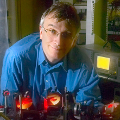
Speaker: Karl Unterrainer
Affiliation: Technical University Vienna
Abstract: Quantum cascade lasers (QCLs) are most successful quantum devices which cover a broad spectral range from the infrared to the THz. However, their operation is still limited in terms of operating temperature, output power and beam properties. Therefore, we investigate new materials system and active regions designs. We use InGaAs/GaAsSb due to the lower effective mass and lower conduction band offset. We have achieved record operating temperatures despite the large interface roughness asymmetries in this material. We compare this to InGaAs/InAlAs structures which show even higher operating temperatures. For InAs/AlAsSb quantum cascade structures lasing is observed in moderate magnetic fields.
The unique properties of QCLs allow the fabrication of double metal micro-cavities. They show very low loos and coupling between them allows the realization of circuits. We show that quantum cascade structures can also work as detector, modulator and amplifier. The coupling between the devices can be adjusted from weak to strong coupling with an unexpected dependence due the existence of an exceptional point. A broadband amplifier for femto-second laser generated few-cycle THz pulses is realized by integrating a photoconductive switch.
Biography: Karl Unterrainer received the MS degree in Physics from the University of Innsbruck in 1986, and his Ph.D. degree in 1989 for his work on stimulated far infrared emission. In 1992, he became assistant professor at the Technical University Vienna. In 1994 and 1995, he worked as a visiting researcher at the Quantum Institute, University of California, Santa Barbara. Since 2004, he is a full Professor at the Photonics Institute, Technical University Vienna. He is coordinating the FWF research cluster “Infrared Optical Nanostructures IR-ON.”
For more information, contact Prof. Ben Williams (bswilliams@ucla.edu)
Date/Time:
Date(s) - Feb 22, 2016
3:00 pm - 4:30 pm
Location:
E-IV Maxwell Room #57-124
420 Westwood Plaza - 5th Flr. , Los Angeles CA 90095