

News | April 20, 2026
In this Issue
Latest News & Awards
- Ozcan and DiCarlo Labs Publish Paper on AI-powered Portable Biosensor for Cardiac Biomarker Testing
- Distinguished Professor Yahya Rahmat-Samii Delivers the Raj and Jeanette Mittra Distinguished Lecture at Penn State University
- Photonics Spectra Magazine Highlights Ozcan Lab’s Research on Label-free Virtual Tissue Staining Leading to the Creation of Digital Twins in Histology
- Boyue Du Wins Culture Impact Award at NVIDIA GTC Hackathon
Events/Seminar
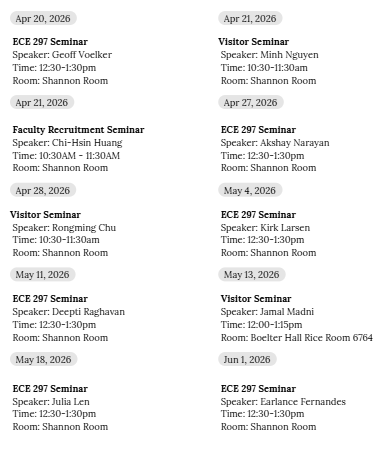
- ECE 297 Seminars: Weekly seminars scheduled for Mondays
- Faculty Recruitment Seminar: Chi-Hsin Huang on April 23
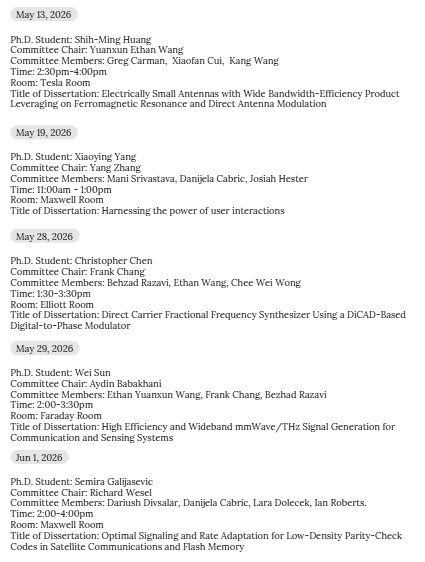
Upcoming PhD Defenses
- 10 Upcoming Defenses
Student Organizations
- HKN Winter Mentorship Program
Volunteering Opportunities
- IEEE IMS Student Volunteer Opportunity
Job Opportunities
- Aerospace Corporation Communication Architectures Modeling and Analysis Engineer Opportunity
- Nanyang Technological University Faculty Positions
- Solidigm Internship Opportunity
- ITAM Mexico City Faculty Positions
- CSULB Assistant Professor Positions
- Cellular SOC Design Verification Engineer Opportunity
- CMU ECE Faculty Position
- AWS Neuron Science PhD Internship Opportunity
- Part-Time Developer for Professor Pirouz Kavehpour
- Sophia Space Internship Opportunity
News
Ozcan and DiCarlo Labs Publish Paper on AI-powered Portable Biosensor for Cardiac Biomarker Testing
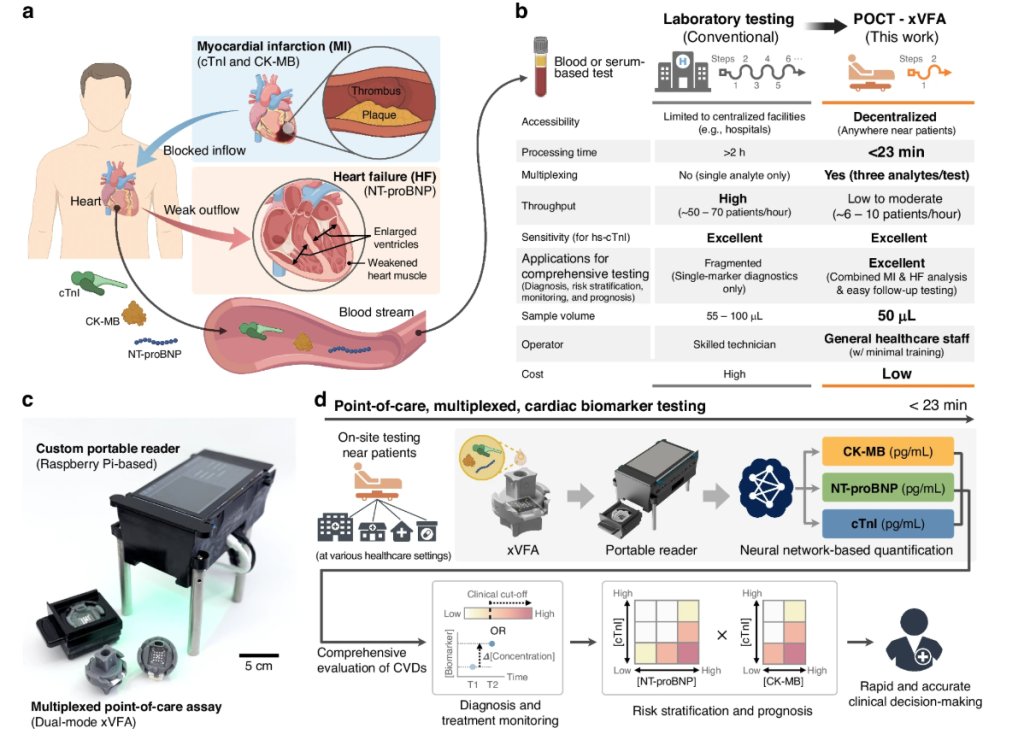
UCLA’s Ozcan Lab, in collaboration with Dr. Dino Di Carlo’s lab, published a new paper on an AI-powered portable biosensor for rapid and multiplexed cardiac biomarker testing. This work demonstrates that combining colorimetric and chemiluminescent biosensing within a single paper-based test, together with neural network-based signal analysis, enables accurate multiplexed detection of three key cardiac markers (cTnI, CK-MB, and NT-proBNP) across clinically relevant concentration ranges, improving point-of-care diagnostics.
Please see the paper and the news release.
Photonics Spectra Magazine Highlights Ozcan Lab’s Research on Label-free Virtual Tissue Staining Leading to the Creation of Digital Twins in Histology
The Photonics Spectra Magazine recently reported an article highlighting Prof. Aydogan Ozcan’s research on label-free virtual tissue staining. Ozcan explained how transferring microscopy images into virtual tissue stains leads to the creation of digital twins in histology; these virtual stains can be produced by GPUs that accelerate image generation based on parallel analysis. Ozcan believes machine learning methods can sidestep human error and reagent contamination that may occur in laboratories performing traditional hematoxylin and eosin staining.
Please see the news release.
Distinguished Professor Yahya Rahmat-Samii Delivers the Raj and Jeanette Mittra Distinguished Lecture at Penn State University
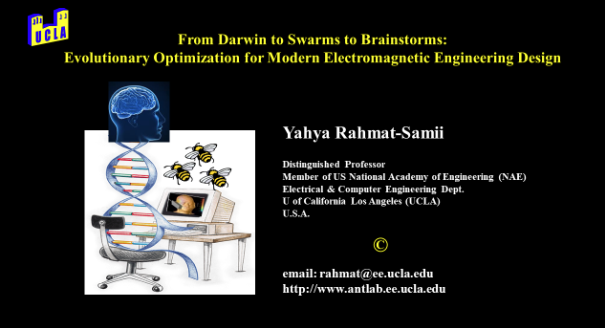
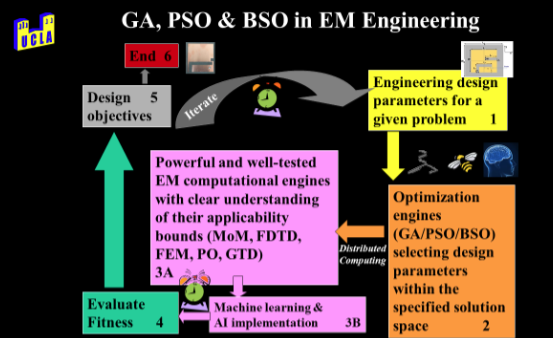
Distinguished Professor Yahya Rahmat-Samii delivered an hour-long Raj and Jeanette Mittra Distinguished Lecture titled “From Darwin to Swarms to Brainstorms: Evolutionary Optimization for Modern Electromagnetic Engineering Design.” The talk was held at Penn State University in State College, Pennsylvania, on Friday, April 10, 2026, and was sponsored by the Department of Electrical Engineering and the School of Engineering.
The Distinguished lecture highlighted the rapidly expanding role of advanced computational techniques in the optimal design of complex engineering systems, emphasizing the growing importance of Evolutionary Optimization (EO) methodologies over traditional brute-force approaches. It focused on nature-inspired algorithms, including Genetic Algorithms (GA), Particle Swarm Optimization (PSO), and Brain Storm Optimization (BSO), explaining their underlying principles and recent advances. The presentation demonstrated the application of these techniques to a wide range of electromagnetic engineering problems: spanning space and planetary missions, medical and wireless devices, multifunctional and adaptive antennas, metamaterials, and nanostructures – while also assessing their practical advantages and limitations. In addition, it discussed the integration of machine learning and AI platforms to accelerate computational processes and further enhance optimization efficiency.
Awards
Boyue Du Wins Culture Impact Award at NVIDIA GTC Hackathon
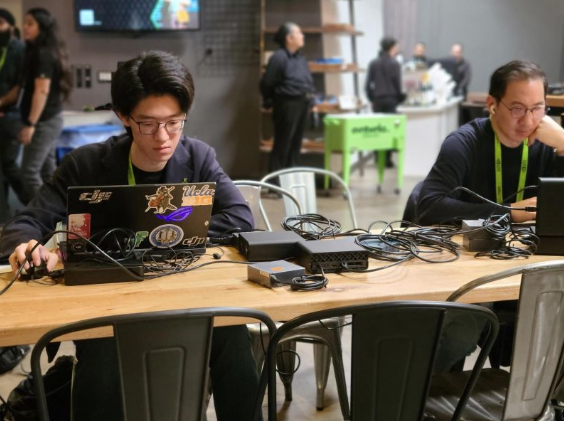
Boyue Du, a Master’s student in UCLA’s ECE department, recently participated in the NVIDIA GTC 2026 Hackathon. During the event, he developed Symphonia Studio, an AI-powered classical music discovery and visualization web application. The project features composer recommendation based on user music preferences, guided listening with structure explanations, emotional music visualization, and instrument interaction visualization.
The project received the Culture Impact Award at the hackathon, and Du was awarded an HP ZGX NANO G1n AI workstation as the prize.
Please see the project and the news release.
Events/Seminars
Upcoming PHD Defenses

Student Organizations
Invitation to Mentor: Connect with the Next Generation of UCLA ECE Students
The UCLA chapter of Eta Kappa Nu (HKN) is launching its Spring Mentorship Program and is looking for alumni to help bridge the gap between academic life and industry reality.
We are seeking UCLA engineering mentors to:
- Provide 1:1 advice to current students.
- Share insights on current industry trends.
- Help students understand what it takes to thrive in the field today.
This year, we are looking for Mentors that are UCLA HKN Alumni, UCLA ECE Master/PhD students, or UCLA EE/CE/CSE seniors.
We are also planning an in-person get-together in late May for mentors and mentees in the Spring (food provided!) to help build community and connect face-to-face.
Whether you are working in hardware, software, or research, your experience is invaluable to the next generation of Bruins.
How to Join:
If you are willing to mentor a student this Spring Quarter, please fill out this brief form.
Volunteering Opportunities
2026 IEEE International Microwave Symposium Student Volunteer Opportunity
The organizing committee for the 2026 IEEE International Microwave Symposium (IMS) invites undergraduate and graduate students working in RF, microwave, and related areas to participate as student volunteers at IMS 2026.
The IMS is the flagship conference of the IEEE Microwave Theory and Techniques Society (MTT-S), and the 2026 event will be held in Boston, Massachusetts. It promises to be an exciting opportunity for students to engage in cutting-edge research, network with professionals and academics, and gain valuable experience helping organize a premier international conference.
The IMS organizing committee is seeking enthusiastic, responsible undergraduate and graduate students who are eager to contribute their time and energy in exchange for an enriching professional experience.
Applications:
Please contact yanghyokim@umass.edu, pmohanku@mathworks.com, and a.nagulu@northeastern.edu for more information.
Job Opportunities
Aerospace Corporation Communication Architectures Modeling and Analysis Engineer Opportunity
The Aerospace Corporation in El Segundo, CA is seeking a BS, MS, or PhD level new grad for the Communication Architectures Modeling and Analysis Engineer position in the Communication Architectures Department (CAD). CAD has three main lines of work: the department performs trade studies, analyses, and simulations to optimize the overall communications performance of terrestrial, satellite, launch vehicle, and ground-based systems. CAD also guides the development of spectrum regulations and policies to assure critical wireless systems have access to necessary spectrum resources. Finally, CAD is actively engaged in the development of RF communications prototypes, especially those involving commercial LEO satellite systems.
Please see the application.
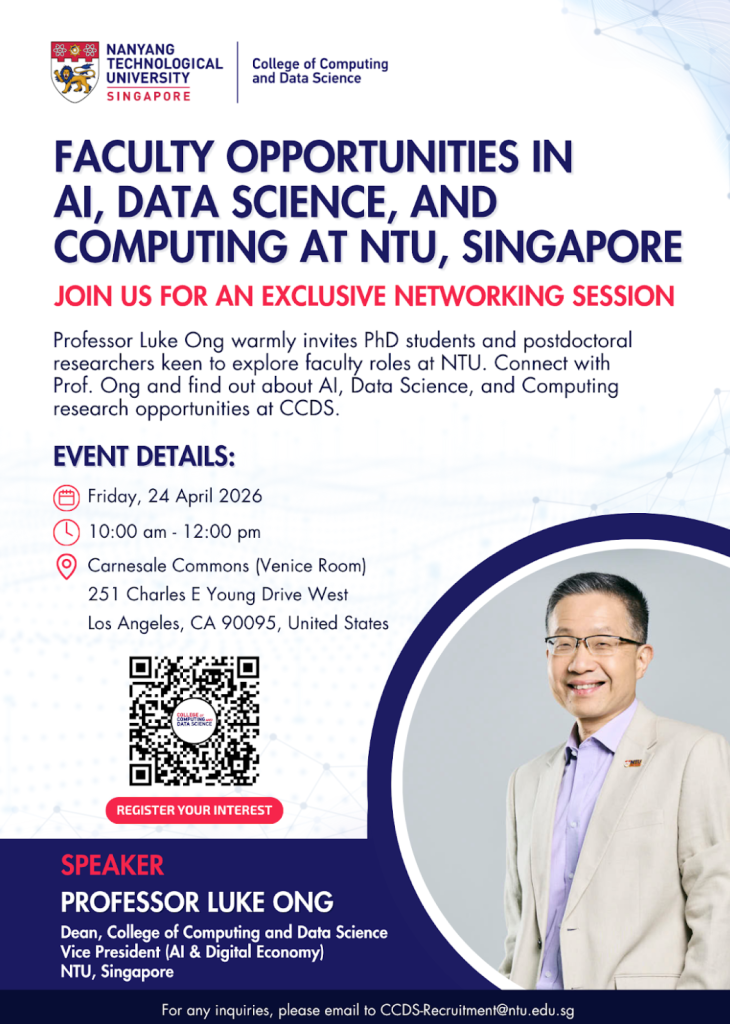
Nanyang Technological University Singapore Faculty Recruitment Outreach Trip
Nanyang Technological University Singapore will host an early-career information session for graduating PhD students and postdoctoral researchers interested in exploring faculty opportunities at NTU.
Solidigm Internship Opportunity
Solidigm, a leading SSD company advancing cutting-edge AI technologies, is currently opening an internship position for senior graduate students. This internship has the potential to convert to a full-time offer upon strong performance.
Internship Requirements:
- Master’s or Ph.D. students, graduating this year or next year (Ph.D. candidates preferred)
- Availability for at least a 6-month internship
- Strong software coding skills
- Solid background in AI, including unsupervised learning, Large Language Models (LLMs) and Reinforcement Learning
- Knowledge of SSD/storage systems is a plus
Can be remote.
Please email Lei Chen at Lei.Chen@solidigm.com if you are interested in this internship opportunity.
Faculty Positions: Electrical Engineering ITAM (Mexico City)
The Department of Electrical and Electronic Engineering at ITAM (Instituto Tecnológico Autónomo de México) invites applications for Tenure-track Assistant Professors, postdoctoral fellows, and Visiting Professors in the following areas:
- Electronics & Electrical Power Systems
- Mechanical Systems and (Cyber-) Physical System Dynamics
- Control Systems
- Signal Processing
- Telecommunications Networks and IoT
Requirements
- Ph.D. (or near completion) from a top-tier university in electrical or mechanical engineering.
- A proven record of high-quality research and peer-reviewed publications.
- A commitment to excellence in teaching and institutional service.
- No Spanish proficiency is required (classes can be taught in English).
Application Instructions
Review of applications begins immediately. Please submit the following documents to enlaceadministrativodai@itam.mx:
- Cover Letter: Stating desired rank, research vision, and teaching philosophy.
- Curriculum Vitae: Including a complete publication record.
California State University, Long Beach (CSULB) Hiring for Assistant Professor Positions
The Department of Computer Engineering and Computer Science (CECS) at California State University, Long Beach invites applications for three tenure-track Assistant Professor positions in Software Engineering, Computer Engineering, Cybersecurity, or closely related areas, beginning August 17, 2026.
Application Submission and Deadline
For full position descriptions and the application portal, please visit:
- Assistant Professor of Cybersecurity
- Assistant Professor of Computer Engineering
- Assistant Professor of Software Engineering
Review of applications will begin January 20, 2026, and the position will remain open until filled or recruitment is canceled.
Cellular SOC Design Verification Engineer – Entry Level at Apple
Do you have a passion for invention and self-challenge? This position gives you an opportunity to be a part of one of the most cutting edge and key projects that Apple’s Silicon Engineering Group has embarked upon to-date. As a Design Verification Engineer on our team, you’ll be at the center of the verification effort within our silicon design group responsible for crafting and productizing state-of-the-art Cellular SoCs!
You will have the opportunity to contribute to the verification effort of a set of complex SOCs delivering the Cellular solution. You will integrate multiple sophisticated IP level DV environments, craft highly reusable best-in-class UVM based test bench, implement effective coverage driven and directed test suites, deploy new tools and methodologies to deliver chips that are right-first-time. By collaborating with other product development groups across Apple, you can push the industry boundaries of what cellular systems can do and improve the product experience for our customers across the world!
Minimum Qualifications:
- BS in EE or CS is required
- Object Oriented Programming
- Coursework in Digital Design
Preferred Qualifications:
- MS in EE or CS
- Coursework in Computer Architecture, Networking Protocol
- Should be a great teammate with excellent communication and problem-solving skills and the desire to seek diverse challenges.
- Programming experience in SystemVerilog, Python, C++
Application details:
1. Please include your current GPA with your resume
2. Please send resume directly to Junhui Lou at j_lou@apple.com
Carnegie Mellon University – ECE Faulty Position
The Department of Electrical and Computer Engineering at Carnegie Mellon University invites applications for tenure-track, research-track, and teaching-track faculty positions at all ranks on our Pittsburgh campus. Although we welcome applicants in all areas of ECE, this year we are particularly interested in candidates whose research focuses on machine learning and artificial intelligence.
Our top-ranked department offers a highly collaborative environment, world-class research infrastructure, and strong support for interdisciplinary scholarship. Applicants should hold a PhD in a relevant field. Application review will begin shortly and will continue until the positions are filled.
Faculty application link: https://apply.interfolio.com/174597
When applying, please also email Andrea Zanette at zanette@cmu.edu
Hiring PhD Interns/FTE for Training and Inference of Foundation Models in AWS Neuron Science
From Amazon Web Services Neuron Science:
Our team in AWS AI Research is looking for a couple of PhD FTE/interns passionate about advancing fundamental research in foundation models. Our algorithm team focuses on developing innovative solutions in the topic of Algorithm-System for LLMs (efficient model design, training, inference) LLM-for-System (LLMs and agents that write optimized kernels). These efforts require both a strong theoretical foundation and a practical understanding of topics such as foundation modeling, distributed optimization, model compression, and machine learning systems. We work closely with system researchers to ensure our algorithmic solutions are compatible with system and hardware constraints, training and testing end2end in accuracy and speed. At the same time, the algorithmic innovation we bring can contribute improving systems and future hardware feature to incorporate.
Basic Qualifications
- Hands-on experience with large language models (LLMs), including:
- Model architecture, datasets, evaluation metrics, and pre-/post-training techniques
- Distributed training techniques, such as parallelism, mixed-precision methods, optimizers, stochastic rounding, and IO-aware training
- Compression and inference strategies, including pruning, quantization, and speculative decoding
- Post-training of SFT and RL to enhance reasoning capability
- Leveraging LLM to improve ML system and kernel programming
- Eager to learn effective system kernel implementation if needed
- Enrolled PhD student in Computer Science, Electrical Engineering, Mathematics, or a related field
- First authored papers in top venues like NeurIPS, ICLR, ICML.
Preferred Qualifications
- Strong theoretical background, such as distributed optimization, compression, or RL
- Strong hands-on experience on pre-training (e.g., low-precision training) or post-training (e.g., SFT, RLHF, GRPO)
- Proven experience with foundation models, including LLMs, multi-modal models
- Experience in establishing scaling laws for training and inference time-scaling
- Knowledge of distributed systems and experience developing low-level, high-performant kernels
Selected Publications
This year, our team has published multiple papers that bridge the gap between theory and practice in LLM research. We also actively collaborate with system and hardware engineers across the AWS organization to deliver tutorials. Below is a list of recent publications:
- [Under review] MuonBP: Faster Muon via Block-Periodic Orthogonalization Arxiv
- [Under review] Scaling Laws Meet Model Architecture: Toward Inference-Efficient LLMs Arxiv
- [Under review] TritonRL: Training LLMs to Think and Code Triton Without Cheating Arxiv
- [Under review] Demystifying Transition Matching: When and Why It Can Beat Flow Matching Arxiv
- [Under review] Not-a-Bandit: Provably No-Regret Drafter Selection in Speculative Decoding for LLMs Arxiv
- [IJCAI 2025] Tutorial: Scaling LLM Training: Efficient Pre-training & Fine-tuning on AI Accelerators
- [AISTATS 2025] Training LLMs with MXFP4 Paper
- [AISTATS 2025] Stochastic Rounding for LLM Training: Theory and Practice Paper
- [ICML 2025] ProxSparse – Regularized Learning of Semi-Structured Sparsity Masks for Pretrained LLMs Paper
- [ICML 2025] RoSTE – An Efficient Quantization-Aware Supervised Fine-Tuning Approach Paper
- [ICML 2025] WaveletToken – Enhancing Foundation Models for Time Series Forecasting via Wavelet-based Tokenization Paper
- [ICML 2024] Collage: Light-Weight Low-Precision Strategy for LLM Training Paper
- [ICML 2024] Variance-reduced Zeroth-Order Methods for Fine-Tuning Language Models Paper
- [ICML 2024] MADA: Meta-Adaptive Optimizers through Hyper-gradient Descent Paper
- [ICML 2024] EMC^2: Efficient MCMC Negative Sampling for Contrastive Learning with Global Convergence Paper
- [NeurIPS 2024] Posterior Sampling with a Diffusion Prior for Online Learning Paper
- [IEEE BigData 2024] HLAT: High-quality Large Language Model Pre-trained on AWS Trainium Paper
- [KDD 2024] Survey: Inference Optimization of Foundation Models on AI Accelerators Paper
- [KDD 2024] Tutorial: Inference Optimization of Foundation Models for AI Accelerators
- [KDD 2023] Tutorial: Training Large-scale Foundation Models on Emerging AI Chips
We also collaborate more system-oriented topics like publications below
- [MLSys 2025] Marconi: Prefix Caching for the Era of Hybrid LLM Paper
- [MLSys 2025] ScaleFusion: Scalable Inference of Spatial-Temporal Diffusion Transformers for High-Resolution Long Video Generation Paper
- [MLSys 2025] FastTree: Optimizing Attention Kernel and Runtime for Tree-Structured LLM Inference Paper
If you are excited to push the boundaries of foundation model research and make impactful contributions, we would love to hear from you! We also constantly hire full-time PhDs. Please send your CV to Youngsuk Park pyoungsu@amazon.com | youngsuk@cs.stanford.edu (cc Kaan Ozkara kaanozka@amazon.com) with a short paragraph of your interest.
Part time Project with Professor Pirouz Kavehpour
We’re seeking an expert developer for a project‑based engagement (not hourly) to build and optimize scalable applications, deploy on Azure Cloud, and integrate GPU‑accelerated embedding software. This role requires deep technical expertise, independence, and the ability to deliver high‑quality solutions within defined project milestones.
What You’ll Work On
- GPU Embedding Service (Containerized)—FastAPI (Python), ML/embeddings, Docker + NVIDIA Container Toolkit, Azure GPU (VM/AKS/ACI), CI/CD with Azure Container Registry (ACR).
- Triage Pipeline with DB & Integrations—Node.js/TypeScript (workers/cron), PostgreSQL (SQL, locks), REST API integration, Azure services (Blob, AI Search, Webhooks).
- Website Integration & Admin UI—Next.js 15 (App Router, API routes, Server Actions), TypeScript + React, PostgreSQL queries, UI/UX for job tables & status.
Requirements
- Expertise in Next.js 15, Node.js, TypeScript, React, and PostgreSQL.
- Hands‑on experience deploying to Azure (preferably using ACR, AKS/ACI, Web Apps, andmanaged services).
- Proficiency with containerized GPU workflows (Docker, NVIDIA Container Toolkit).
- Strong understanding of REST APIs, background workers/cron, SQL performance (indexes,
locks), and secure auth patterns. - Track record of independently delivering production‑grade solutions on schedule and tospec.
Nice to Have
- FastAPI and Python ML/embeddings experience.
- Azure AI Search, Blob, and Webhooks integrations.
- CI/CD pipelines (GitHub Actions or Azure DevOps).
- Admin UI/Design System experience for operational dashboards.
How We Work
Project‑based milestones, clear acceptance criteria, frequent check‑ins, and code reviews.
We value pragmatic engineering, performance, and maintainability.
Send your information to: Prof. Pirouz Kavehpour—Pirouz@seas.ucla.edu
Electrical/Computer Engineering Intern at Sophia Space
A well-funded deep-tech startup in Pasadena is seeking Electrical/Computer Engineering Interns to help develop its AI-powered product prototypes. The interns are expected to blend electronics hardware and embedded software to build groundbreaking AI infrastructure in space. Roles are available full-time or part-time starting immediately, with the option to continue part-time (~10–15 hrs/week) during the academic year.
Please see this link for more information regarding this position.
Newsletter Submissions
To be included in future newsletters, please send the latest news, awards, publications and any upcoming PhD oral defenses to the Chair’s assistant, Winda Mak, at wmak@seas.ucla.edu. Please include “newsletter submission” in the subject line. The ECE newsletters will be sent bimonthly on the first and third Mondays of the month. Please ensure all submissions are received by the Wednesday before distribution to be included in the newsletter.